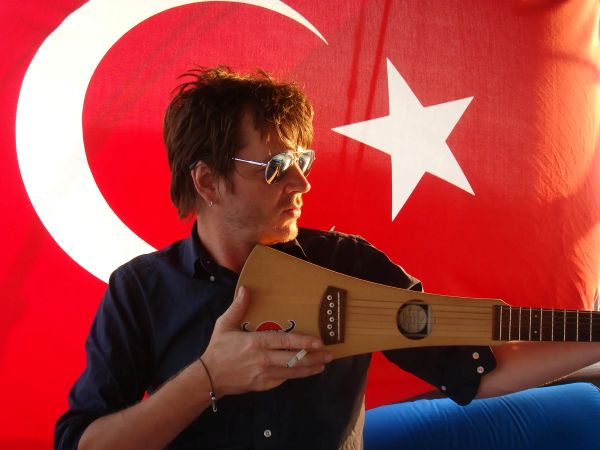
Formed in 1995 by Tod A, Firewater emerged from New York City’s fertile underground rock scene with an ambitious idea: take the energy of punk rock and crossbreed it with a variety of different music from around the world. Tod A had been the bassist, vocalist & primary songwriter of the influential noise-rock band Cop Shoot Cop, but Firewater allowed him the creative freedom to explore klezmer, gypsy music, ska, jazz, cabaret, folk and a host of other traditions. The end results were what some would later call ‘world punk.’ Their 1996 debut, Get Off the Cross, We Need the Wood for the Fire, a bold departure from the sound Tod A had been known for, was followed by The Ponzi Scheme in 1998, a more finely tuned sophomore effort. Tod A began to envision Firewater as more of an amorphous musical collective than a conventional rock band with rigidly defined roles. Those early recordings brought together musicians from across the alternative diaspora, including Duane Denison of the Jesus Lizard, Yuval Gabay of Soul Coughing, Jennifer Charles of Elysian Fields, and Hahn Rowe of Hugo Largo. What truly made Firewater unique, however, was not the wild array of disparate genres the band giddily embraced, but the manner in which they made those styles seamlessly coexist into Firewater’s own cohesive sound. Eastern European melodies, Indian ragas, accordion & saxophone melded with distorted guitars, jagged, punky rhythms and Tod A’s sardonic lyrics. The music could be at once exuberant & danceable while framing lyrics that remained viscerally cynical and haunted by mortality. The band continued to evolve through Psychopharmacology (2001) and The Man on the Burning Tightrope (2003). 2004’s Songs We Should Have Written found the band reinterpreting songs by a diverse selection of artists including Johnny Cash, the Rolling Stones, Robyn Hitchcock, & Sonny & Cher, transforming familiar material through the filter of Firewater’s dark, international musical vocabulary. Touring doggedly for nearly a decade, Firewater earned a devoted following on the European festival circuit and among American college-radio audiences. The most dramatic transformation by far came when Tod A pulled up stakes to travel though India, Pakistan, Thailand & Indonesia. His ensuing experiences crossing that far-flung terrain and mixing and mingling with the locals profoundly influenced & informed the next album, The Golden Hour, released in 2008. Recorded with musicians encountered during those travels, as well as with longtime collaborators, the album expanded Firewater’s sonic palette on a whole new level. Travel had become part of Tod A’s creative process. The band returned in 2012 with International Orange, continuing its mixture of pugnacious punk, global rhythms, and dark, politically infused lyrics. Long before bands like Gogol Bordello found success melding genres, Firewater had made musical cross-collaboration and cultural osmosis its modus operandi. Through its rotating cast of collaborators and co-conspirators, Tod A built Firewater into a versatile musical experiment, voraciously curious and constantly crossing borders — both musically and literally — with abandon. Firewater returns to action after a decade plus long hiatus with a new album Bad Jazz which drops 12/11 on Pravda Records.